Every angler knows the sinking feeling of watching their bow motor struggle against a stiff headwind at two in the afternoon. You step on the foot pedal, the prop barely spins, and you realize your day on the water is officially cut short. For decades, traditional lead-acid and Absorbent Glass Mat (AGM) power banks were the only realistic game in town. Today, Lithium Iron Phosphate (LiFePO4) technology has completely transformed marine electrical systems.
Choosing the right power source is not just about raw power; it dictates your boat’s draft, top-end speed, run time, and how often you will have to replace heavy battery banks. Evaluating a trolling motor battery lithium vs agm setup comes down to understanding the critical trade-offs between upfront purchase price and real-world performance on the water.
Weight Reduction and Hull Performance
The most immediately noticeable difference between battery chemistries is the physical weight sitting inside your bilge or bow storage compartment. Lead is heavy, and boats hate unnecessary weight.
Shedding Bilge Weight for Speed and Draft
A standard group 31 12v marine deep cycle battery built with AGM technology weighs anywhere between 65 and 75 pounds. If you run a modern 36-volt trolling motor system, you have three of those monster batteries strapped into your compartments. That adds over 200 pounds of dead lead to the hull before factoring in your onboard charger, wiring, tackle, and fuel.
Switching to a trolling motor battery lithium vs agm alternative cuts that weight by roughly 70 percent. A comparable 100Ah LiFePO4 battery weighs around 24 to 28 pounds. Dropping 140 pounds out of your boat changes its entire running profile. Your boat gets on plane faster, gains top-end speed, burns less outboard fuel, and drafts significantly shallower in skinny backwaters.
Handling Rough Water and Hull Balance
Where that weight sits matters just as much as how much you carry. In small aluminum bass boats, flats skiffs, or bay boats, packing 200 pounds of lead into the stern makes the boat squat low in the water. This leaves you vulnerable to taking wakes over the transom when you come off the plane.
By upgrading your trolling motor battery lithium vs agm configuration to lightweight lithium, you restore the hull’s natural center of gravity. The bow lifts easier in rough chop, resulting in a drier, safer ride across big water.
Voltage Curves and Usable Power Delivery
The biggest mechanical advantage of lithium over AGM is not the weight savings; it is the way each battery discharges its stored energy.
The 50 Percent Depth of Discharge Trap on AGM
On paper, a 100-amp-hour AGM battery sounds like it offers 100 amp-hours of fishing time. In the real world, it does not. Traditional lead and AGM batteries should never be discharged below 50 percent of their total capacity. Discharging an AGM battery past 50 percent causes severe plate sulfation, which permanently destroys its storage capacity and slashes its lifespan. You are effectively carrying 70 pounds of lead to access only 50 amp-hours of usable juice.
When you compare a trolling motor battery lithium vs agm bank, lithium can be safely drained down to 100 percent of its capacity without damaging the internal cells. A 100Ah lithium battery delivers a full 100 amp-hours of run time, giving you essentially double the usable fishing hours in a package that weighs half as much.
Flat Voltage Curves vs. Sluggish Motor Performance
AGM batteries suffer from a steady, sloping voltage drop. As you drain the battery, the voltage continuously drops from 12.7 volts down to 11.8 volts. Because electric trolling motors rely on voltage to spin the prop, your motor gradually gets slower and weaker throughout the day. By hour four, your high-speed setting feels like medium speed.
LiFePO4 chemistry behaves completely differently. It maintains a virtually flat voltage curve, holding between 12.8 and 13.2 volts until the battery is practically empty. Whether you are on your first cast at 6:00 AM or battling a heavy river current at 4:00 PM, your motor delivers 100 percent of its rated thrust.
Outfitting 24-Volt and 36-Volt Systems
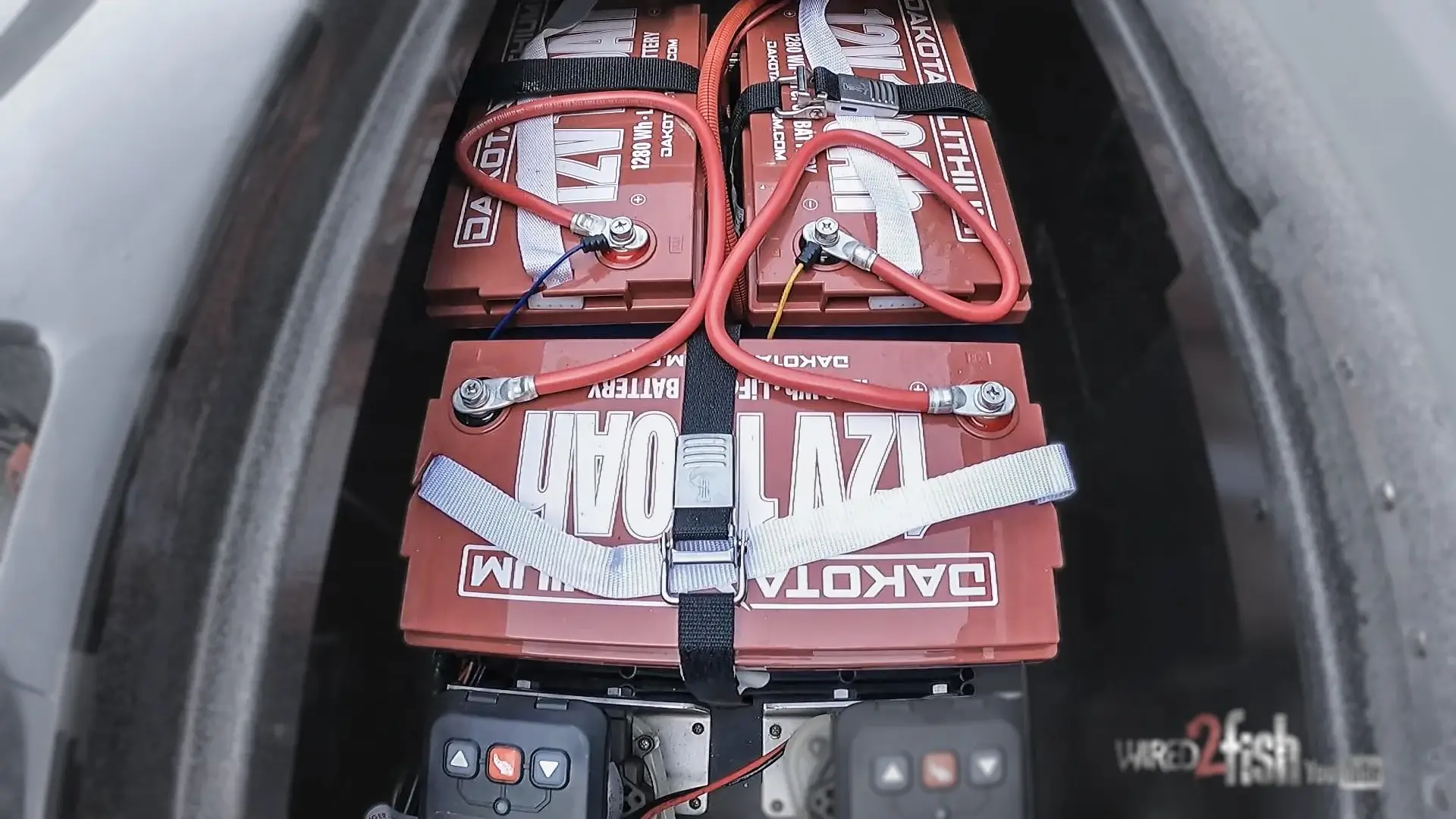
For mid-sized multispecies and bass boats running 70-to-80-pound thrust motors, picking the best battery for 24v trolling motor rigs usually comes down to two simple choices. You can run two 12V lithium batteries in series, or you can drop in a single 24V all-in-one lithium battery. Going with a single 24V unit eliminates jumper cables, frees up massive amounts of compartment space, and reduces points of electrical failure.
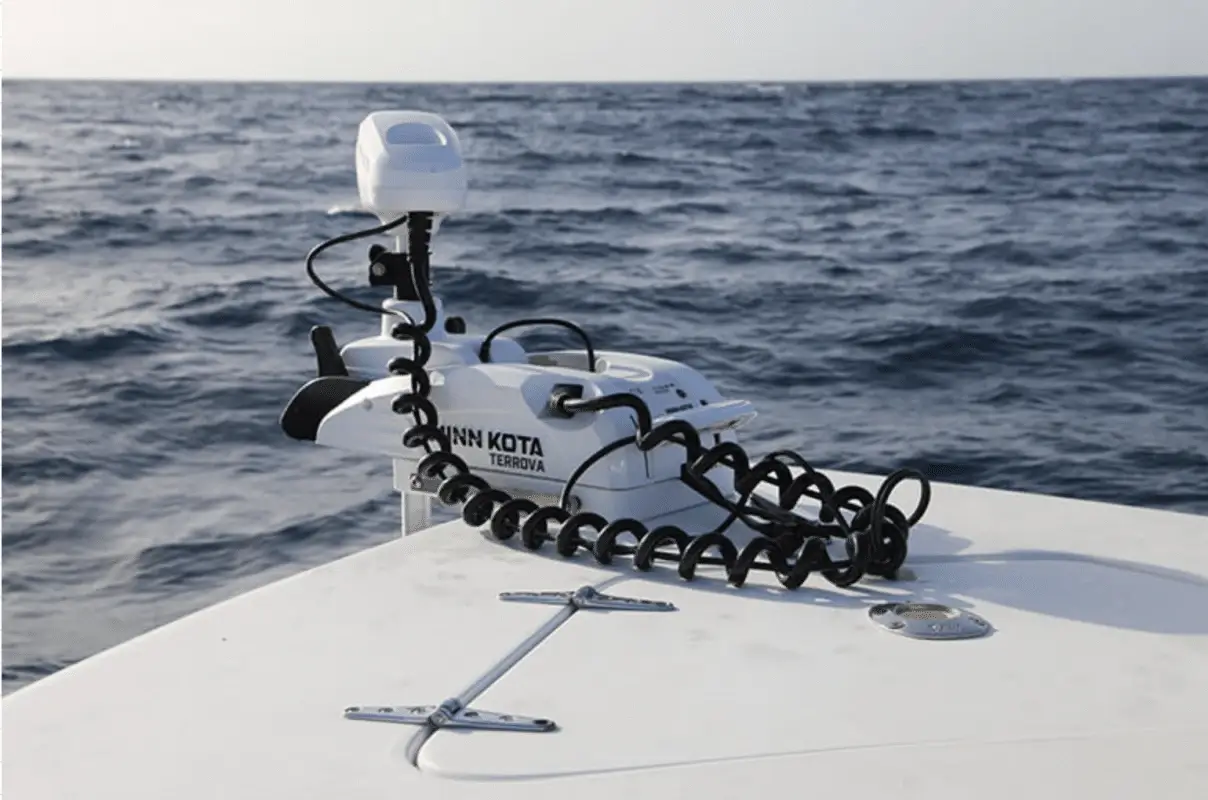
If you are running a modern GPS system, wiring a lithium battery for the Minn kota Spot-Lock unit is incredibly smart. When voltage sags on older AGM batteries, the GPS control board inside the trolling motor head can brown out, causing the motor to randomly unlock and drift off your waypoint. A steady stream of lithium voltage completely cures this glitch.
Lifespan, Cycle Life, and True Cost-Per-Year
The upfront price tag of lithium makes many boat owners hesitate. A quality marine lithium battery costs more right out of the gate than an entry-level AGM battery. However, looking at upfront purchase cost alone is a major financial mistake when working out a trolling motor battery lithium vs agm equation.
A battery cycle represents one full discharge and recharge. A premium AGM battery provides roughly 300 to 500 cycles before its internal lead plates degrade to the point where it can no longer hold a charge. For an angler fishing once or twice a week, an AGM bank typically dies in two to four years.
A quality LiFePO4 marine battery delivers between 3,000 and 5,000 cycles while retaining over 80 percent of its original capacity. Even if you fish 150 days a year, a lithium battery bank will easily last over a decade. In the long run of a standard trolling motor battery lithium vs agm lifecycle, you will burn through three or four sets of heavy AGM batteries in the same timeframe it takes to wear out a single lithium pack.
Charging Protocols and Electrical Safety
Upgrading your boat’s battery chemistry is not a simple drop-in swap. It requires matching your charging infrastructure to the chemical needs of the battery.
Selecting the Right Marine Battery Charger for Trolling Motor Banks
You cannot use an old-school lead-acid charger on a lithium battery bank. AGM batteries require a slow taper charge that tops out around 14.4 volts before dropping into a low-voltage trickle float mode to maintain the charge.
Lithium cells require a constant current and constant voltage charging profile that pushes full amperage until the battery hits roughly 14.6 volts, at which point the charger simply shuts off. Running an incompatible charger will undercharge your lithium battery, trigger safety lockouts, or fail to balance the internal cells. Installing a dedicated multi-bank marine battery charger for trolling motor systems with selectable lithium profiles is absolutely mandatory to protect your investment.
The Role of the Internal Battery Management System
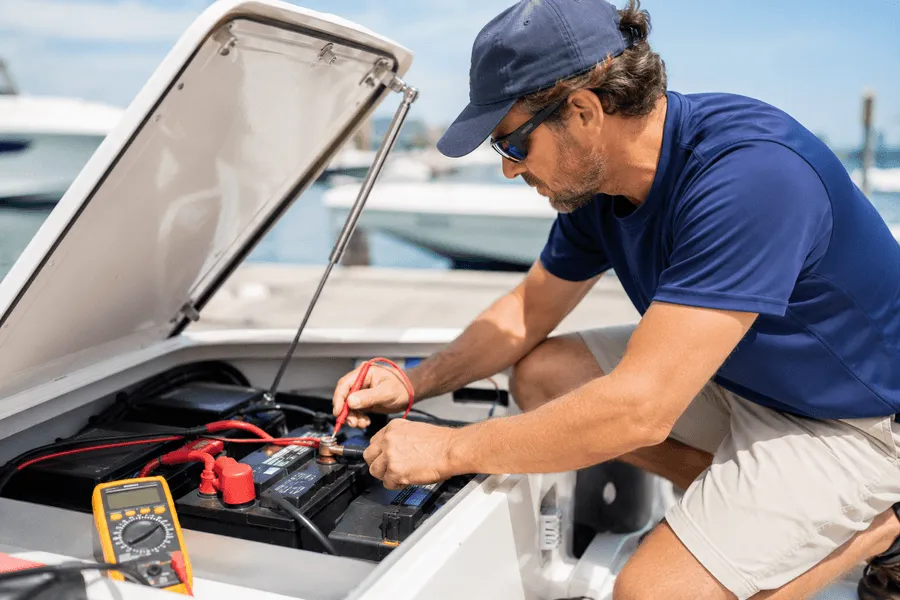
High-grade marine lithium batteries contain a built-in computer board known as a Battery Management System. This board acts as a digital bodyguard. It monitors internal cell temperatures, balances voltage across the internal packs, and automatically cuts power if it detects a dead short, over-voltage, or low-voltage event. More importantly for cold-weather anglers, a good management system prevents the battery from accepting a charge when internal cell temperatures drop below freezing, preventing permanent lithium plating damage.
Common Marine Battery Mistakes and Anglers Solutions
Rigging marine electrical systems requires precision. Cutting corners with wiring, fusing, or battery choices often leaves boaters stranded or dealing with expensive component burnouts. Doing a correct trolling motor battery lithium vs agm upgrade prevents these exact issues.
- Problem: Mixing and matching old and new batteries. Anglers frequently try to save money by replacing just one dead battery in a 24V or 36V trolling motor system while leaving older AGM batteries in the loop. The older, weaker batteries drag down the new battery, causing uneven charging, severe heating, and premature failure of the entire bank.
- Solution: We balance your entire power system. Whether you stick with heavy lead or step up to a full trolling motor battery lithium vs agm conversion, we install matched, balanced banks with identical internal resistance to guarantee uniform power delivery and extended cycle life.
- Problem: Ignoring undersized wiring on high-thrust motors. Modern 80lb and 112lb thrust trolling motors pull up to 60 continuous amps under full load. Factory rigging on older boats often uses thin 8-gauge or 10-gauge wire, which overheats, causes massive voltage drop, and trips circuit breakers constantly.
- Solution: We rewire trolling motor circuits using heavy marine-grade 6-gauge tinned copper wire, high-amperage terminal blocks, and robust 60-amp manual-reset marine circuit breakers designed to handle high continuous amp draws safely.
- Problem: Freezing cell damage during winter charging. Boaters often plug in their onboard chargers inside an unheated pole barn or garage during freezing winter weather, totally unaware that charging a frozen lithium battery instantly ruins the cells.
- Solution: We install premium LiFePO4 batteries equipped with internal heating elements or advanced low-temperature charge cutoffs, paired with smart multi-profile marine chargers to ensure safe off-season maintenance.
Power Your Rig with Anglers Trolling Motor Services
Your time on the water is valuable. Spending a beautiful Saturday fighting sluggish boat control, drifting off your coordinates, or replacing heavy lead batteries every three seasons is an unnecessary hassle. Understanding the true benefits of a trolling motor battery lithium vs agm upgrade allows you to equip your boat with the long-lasting, lightweight power it needs to perform in heavy wind and rolling chop.
At Anglers Trolling Motor Services, we take the frustration out of boat rigging. We specialize in custom trolling motor installations, mechanical repairs, onboard charging setups, and complete lithium battery conversions for bass boats, bay boats, pontoons, and flats skiffs. Our technicians match the exact voltage, amp-hour capacity, and charging curves to your hull and fishing style so you can run hard all day with total confidence. If you are tired of dead batteries cutting your fishing trips short, struggling with sluggish top-end boat speed, or wondering which electrical setup makes sense for your rig, you do not have to figure it out alone. We have the best possible solution for all these problems.